

Active vs Passive Buzzer: How to Choose the Right Buzzer for Your Application
In electronic devices, buzzers are widely used as sound indicators for alarms, notifications, and user interaction. According to their driving method, buzzers are generally divided into two main types: active buzzers and passive buzzers.
Understanding the difference between them helps engineers select the right acoustic component for different applications.
What Is a Passive Buzzer?
A passive buzzer does not contain an internal oscillation circuit. It requires an external driving signal from the control system to generate sound.
By changing the frequency of the input signal, engineers can control different tones and sound effects.
Advantages of passive buzzers:
- Flexible frequency control
- Suitable for applications requiring different sound patterns
- Compatible with various microcontrollers and control systems
- Widely used in industrial equipment, instruments, and electronic devices
For example, QMB-09A-03 is a compact electromagnetic passive buzzer designed for space-limited applications.
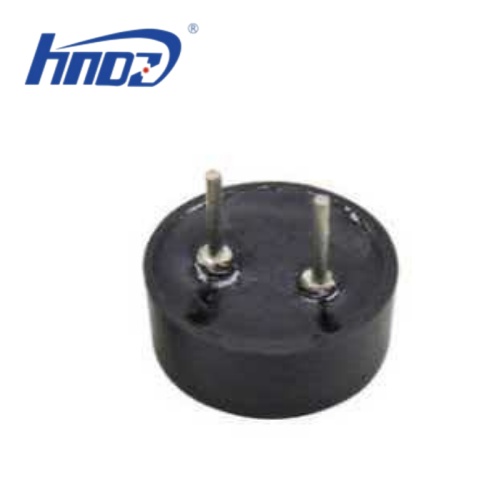
Key specifications:
- Rated voltage: 3Vo-p
- Operating voltage: 1.5~4.5Vo-p
- Sound pressure level: ≥85dB @10cm
- Resonant frequency: 2700±300Hz
- Size: Ø9.0×4.2mm
Its compact structure makes it suitable for applications such as control panels, instruments, and electronic devices.
What Is an Active Buzzer?
An active buzzer integrates an internal oscillation circuit, allowing it to generate sound directly when DC voltage is applied.
Compared with passive buzzers, active buzzers are easier to control because they only require a simple ON/OFF signal.
Advantages of active buzzers:
- Simple driving method
- Easy integration into electronic products
- Stable sound output
- Suitable for alarm and notification systems
For example, HMB1206-03 is a compact electromagnetic active buzzer designed for PCB applications.
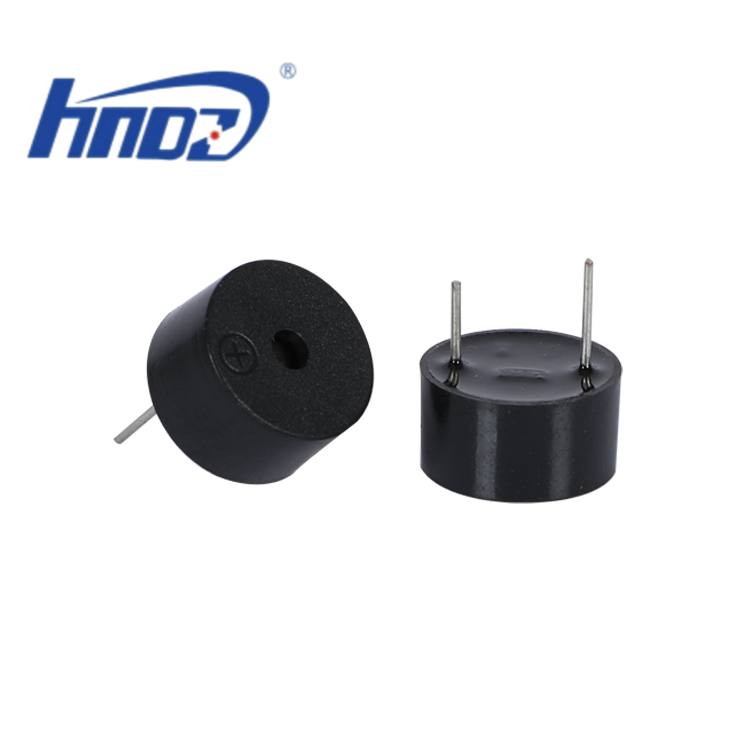
Key specifications:
- Rated voltage: 3VDC
- Operating voltage: 2~5VDC
- Sound pressure level: ≥85dB @10cm
- Current consumption: ≤30mA
- Resonant frequency: 2700±300Hz
- Size: Ø12.0×6.5mm
Active Buzzer vs Passive Buzzer: Which One Should You Choose?
| Feature | Passive Buzzer | Active Buzzer |
|---|---|---|
| Internal oscillator | No | Yes |
| Driving method | External frequency signal | DC voltage |
| Sound control | Flexible | Fixed tone |
| Control complexity | Higher | Lower |
| Typical applications | Industrial control, instruments, smart devices | Alarms, indicators, warning systems |
Professional Buzzer Solutions for Different Applications
Choosing the right buzzer depends on factors such as:
- Product structure
- Available PCB space
- Sound requirements
- Power consumption
- Control method
Jiangsu Huaneng Electronics Co., Ltd. provides customized buzzer solutions including electromagnetic buzzers, piezoelectric buzzers, SMD buzzers, and customized acoustic components for industrial, automotive, smart electronics, and security applications.
With integrated R&D, production, and testing capabilities, Huaneng supports customers from prototype development to mass production.