

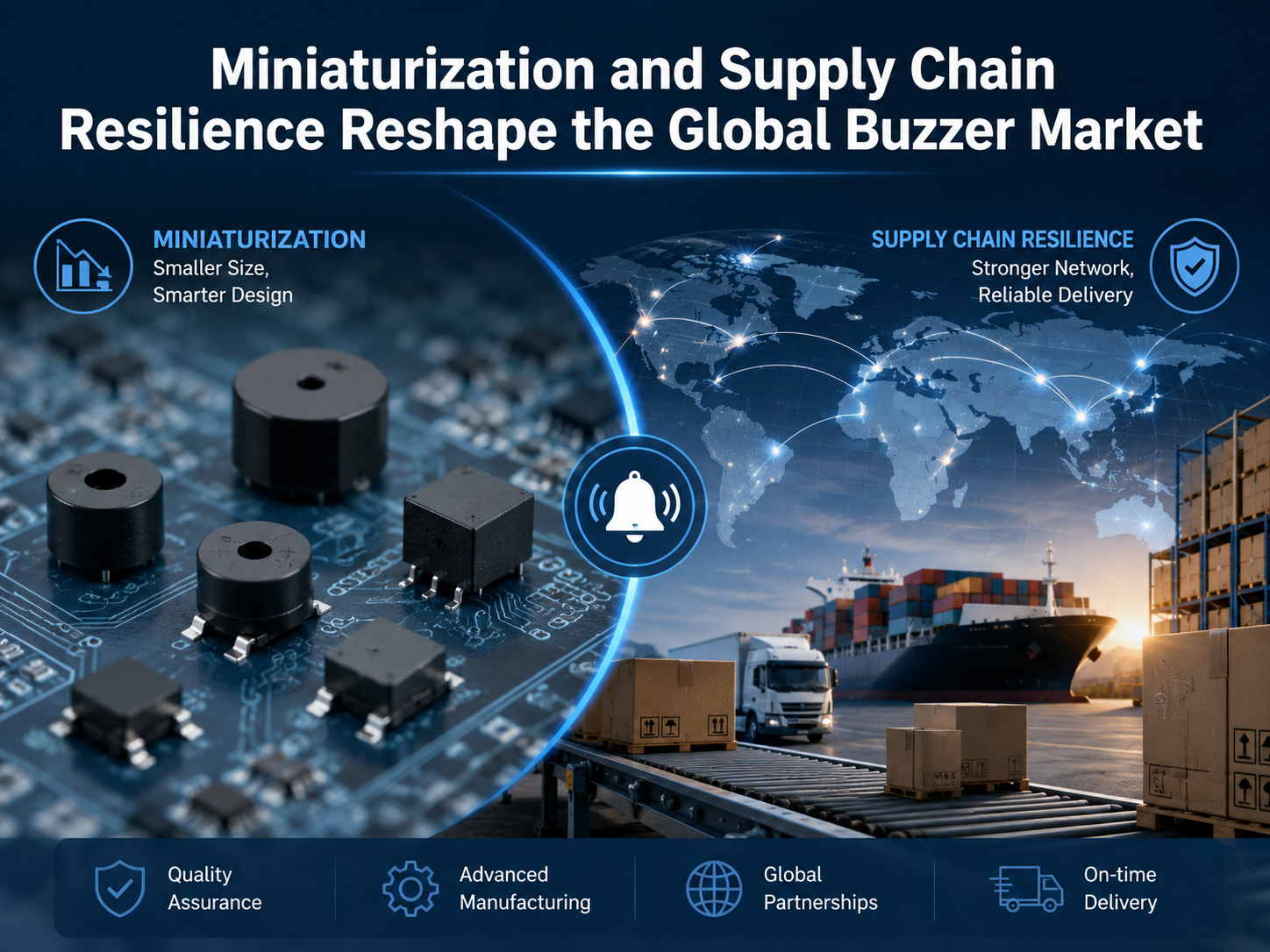
The Miniaturization Imperative
The proliferation of Internet of Things (IoT) devices, smart home ecosystems, and wearable technology continues to fuel robust demand for compact acoustic components. Industry analysts highlight that the transition from traditional leaded buzzers to surface-mount device (SMD) variants is gaining clear momentum across multiple product categories.
This shift is driven by three converging technical requirements in modern electronics design:
- Space efficiency — Smaller device footprints demand components that do not compromise PCB real estate.
- Automated assembly — High-volume manufacturing favors SMD components placed by pick-and-place machines over manual insertion.
- Higher-density designs — Portable and wearable devices leave minimal room for through-hole components.
Smart speakers, security monitoring systems, smart kitchen appliances, drones, and portable consumer electronics all require buzzers that deliver consistent audible alerts while minimizing power consumption and physical size. In response, manufacturers are actively developing ultra-thin SMD buzzers with reduced profiles, enabling seamless integration into increasingly compact electronic designs without sacrificing sound pressure levels or tonal clarity.
Supply Chain Resilience Becomes a Strategic Priority
Recent disruptions in global logistics networks and raw material availability have prompted OEMs and electronic manufacturing service (EMS) providers to fundamentally re-evaluate their sourcing strategies for electro-acoustic components. A decisive industry trend is emerging: buyers are increasingly favoring partnerships with vertically integrated manufacturers capable of controlling the entire production chain internally.
China Consolidates Its Manufacturing Dominance
China continues to serve as the dominant global manufacturing base for electromagnetic buzzers, piezoelectric buzzers, and related electro-acoustic components. The Yangtze River Delta and Pearl River Delta regions remain the most concentrated production clusters, benefiting from mature electronics supply chain ecosystems, skilled technical labor, and well-established export infrastructure.
Leading Chinese manufacturers are actively expanding their international footprint beyond traditional export channels. Participation in major global trade exhibitions such as the HKTDC Hong Kong Electronics Fair has become a standard practice for building direct relationships with international buyers. Direct sales channels into Southeast Asian, European, Middle Eastern, South American, and African markets are being established at an accelerating pace.
For export-oriented manufacturers, the presence of English-speaking sales and technical support teams has evolved from a competitive advantage to a baseline requirement. Effective communication across business negotiation, technical consultation, order follow-up, and after-sales service is now expected as standard by global customers.
Quality and Service as Differentiators
In an increasingly crowded market, ISO 9001:2015 quality management system certification, utility model patents, and comprehensive product test certificates have emerged as critical trust signals. Procurement professionals across automotive, medical equipment, industrial control, and high-end consumer electronics sectors are placing greater weight on suppliers with demonstrable quality control systems and proven R&D capabilities.
The ability to offer end-to-end professional services is also rising in importance. Pre-sales product selection and solution evaluation, in-sales production and quality control follow-up, and after-sales technical support and problem resolution are increasingly expected as standard offerings. OEM customization capabilities—developing products based on customer-specific parameters, specifications, and application scenarios—are becoming a decisive factor in supplier selection.
Looking Ahead
The buzzer industry is expected to see continued consolidation around manufacturers capable of delivering high-end, application-specific products supported by intelligent automation, precision testing, and robust international customer service infrastructure. For procurement professionals, the key evaluation framework is shifting from unit price comparison toward total value assessment—encompassing quality consistency, supply reliability, technical support depth, customization responsiveness, and comprehensive service capabilities.